

Crossville, Tennessee · Our community’s story
The history of Crossville, Tennessee
Roads brought people to Crossville. Railroads opened new markets. Families, builders, and neighbors gave the town its lasting character.
Crossville’s past is written into its landscape: a railroad depot on Main Street, the sandstone homes of Cumberland Homesteads, a theater marquee, and the arches across Byrd Lake. Together, these places tell a story of work, hardship, reinvention, and community effort on Tennessee’s Cumberland Plateau.
Early roads · 1800s
Where the roads met
The settlement that became Crossville grew around the meeting of an east–west road across the plateau and the north–south Kentucky Stock Road. The Walton Road Historic Byway traces this transportation heritage. Travelers needed supplies and somewhere to stop; a store helped establish a small commercial center. By the 1830s, a post office carried the Crossville name.
Its location gained new importance when Tennessee created Cumberland County on November 16, 1855. County government organized in 1856, and Crossville was laid out as the county seat. These are separate milestones from the city’s incorporation in 1901. The crossroads had become a place where people came not only to trade, but also to conduct the business of a growing county.
Historical records: Walton Road Historic Byway · 1855 county-creation act · Historic courthouse nomination (PDF) · City incorporation record.
A town connected · 1900–1926
The railroad changes the pace
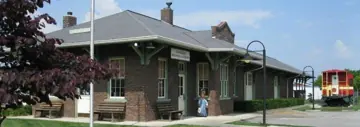
The first Tennessee Central train reached Crossville in September 1900. The station building was not ready, so a boxcar served temporarily as the depot. Rail service gave the community a stronger connection to outside markets, helping local timber and stone reach buyers and bringing more goods and travelers into town.
The depot became a gathering place as well as a transportation hub. Its history includes arrivals by physician May Cravath Wharton, World War I veteran Alvin C. York, and First Lady Eleanor Roosevelt. After the original depot burned in February 1925, a replacement was built across the tracks and completed in May 1926.
That surviving building links present-day Main Street to the railroad era. A community restoration effort began in 1996, giving a familiar landmark a new role after train service had ended.
Historical record: City of Crossville’s Depot history.
The Great Depression · 1934 onward
A new start at Cumberland Homesteads
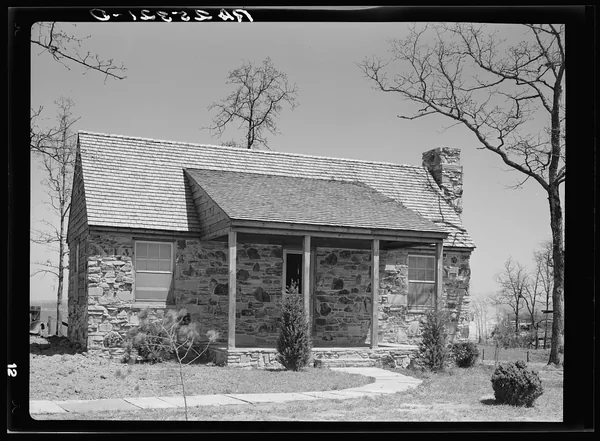
South of Crossville, the Great Depression produced one of the area’s most distinctive communities. Cumberland Homesteads began in 1934 as a federal New Deal effort to help struggling families build a more secure life through housing, small farms, and work. The original plan called for 350 farm units; 251 were built.
Architect William Macy Stanton designed the community and its houses, using native Crab Orchard sandstone to give the homes a recognizable local character. Residents helped build the settlement, with some families living in barns while their houses were under construction. The archival photograph here records one of the Homesteads in April 1937.
The project’s ambitions met difficult realities. Cooperative businesses struggled, and small farms alone could not reliably support every household. Families sought other employment, while disagreements over payments and ownership complicated the transition to private homes. The buildings that remain preserve both the optimism of the New Deal and the hard work of the people who made the community their home.
Historical record: Cumberland Homesteads National Register documentation (PDF).
Public work, lasting places · 1930s
Stone, water, and a park for the community
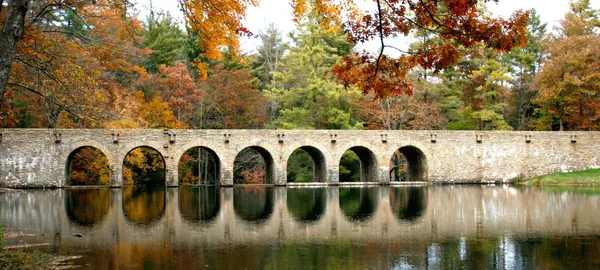
The Homesteads story also reaches into Cumberland Mountain State Park. Tennessee acquired the park in 1938 as a recreation area associated with the Homesteads community. Its setting offered families a place to gather and enjoy the outdoors.
The Civilian Conservation Corps built the park’s remarkable bridge and dam between 1936 and 1938. Faced with Crab Orchard sandstone, the structure carries a roadway over the dam. Its series of arches has become one of the area’s most recognizable views.
Seen together, the Homesteads houses and the park’s masonry show how local materials shaped a whole landscape. They also make the work of Depression-era construction crews visible long after the programs that employed them ended.
Historical records: Tennessee State Parks’ account of the park’s origins · TDOT historic bridge survey, printed pages 548–550 (PDF).
World War II · 1942–1945
Crossville and a world at war
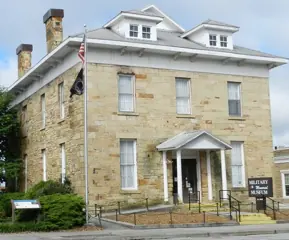
World War II connected Cumberland County to events far beyond Tennessee. Camp Crossville, outside the city, held German and Italian prisoners of war between 1942 and 1945. Its presence brought a major wartime installation into the plateau’s rural landscape.
This is a different chapter from the familiar story of soldiers leaving home to serve overseas: here, the consequences of the war also arrived close to home. Today, the Military Memorial Museum in downtown Crossville is one place to begin exploring the region’s military history. The photograph shows the museum building, not the former prisoner-of-war camp.
Historical record: Camp Crossville history. Visitor information is in our Museums & Local History guide.
Main Street & the stage · 1938 onward
A community that made room for the arts

The Palace Theatre opened on November 21, 1938, bringing a new movie house to Main Street. Its stone facade and Art Deco character made it a distinctive downtown landmark. After closing in 1978, the building deteriorated, but residents organized to save it. The city bought the property in 1993, and voters approved restoration funding in 1996. The Palace reopened in February 2001.
Another cultural story took shape through Paul and Mary Crabtree and the neighbors who supported their vision for local theater. The Cumberland County Playhouse opened on July 15, 1965. Performances, education, professional artists, and community volunteers helped turn an ambitious local project into an enduring part of the area’s identity.
The Palace and Playhouse illustrate two ways a community can invest in itself: preserving a beloved older building and creating a new institution. Their stories belong beside the roads, rail lines, and public works in any account of Crossville’s development.
Historical records: City of Crossville’s Palace history · The Playhouse’s founding story · Playhouse anniversary account.
Recreation & preservation · Later 1900s to today
A destination with roots

Recreation added another chapter to the region’s story. Nearby Fairfield Glade opened its first nine golf holes in 1970, and its first 18-hole course was completed in 1973. The growth of golf and resort communities helped shape the Crossville area’s identity as a place to visit and settle. Fairfield Glade is a neighboring community, part of the wider Cumberland County story.
Looking back, there is a recurring theme: people used the plateau’s location, materials, and landscape to build new opportunities. Today, preserving a depot, a theater, or the Homesteads Tower keeps that history within reach. These are places to encounter the past through actual buildings and the lives connected with them.
Historical records: Fairfield Glade’s golf history · Cumberland Homesteads Tower Association.
About this history guide
This original overview brings together government records, National Register documentation, and histories published by local institutions. The historical-record links beside each section offer further reading. Dates distinguish the county’s legal creation, the organization of its county seat, and the city’s later incorporation. The guide covers Crossville and clearly identified nearby communities; it is an introduction, not a complete account of every family or era.
Have a documented detail to add? Contact CrossvilleOnline with the information and its supporting record.